About Barsana Dham

Holy Places of Barsana Dham

Barsana Dham and Shree Raseshwari Radha Rani Temple is established on 200 acres of scenic land and represents the most important holy district of Braj in India where Shree Radha Rani and Shree Krishn appeared 5,000 years ago. It provides the rare opportunity to experience the true devotional environment that prevailed in the Ashrams of the historic Saints of Vrindaban and Barsana 500 years ago.

Areas of Barsana Dham have been developed to be places for devotional inspiration and meditation. All the important places of Braj like Govardhan, Radha Kund, Prem Sarovar, Shyam Kuti, Man Mandir and Mor Kuti, etc. are represented in Barsana Dham where the natural stream named Kalindi represents the Yamuna river of Vrindaban. Many local visitors and guests from throughout the U.S. and around the world visit Barsana Dham and experience its peaceful and devotional atmosphere.

horizontal rule

Picture of Barsana Hill (and Shreeji Mandir - Temple) in Barsana, India (Varsana)
Picture of Barsana Hill in Barsana Dham, Austin, Texas (a Hindu Temple and Ashram of bhakti yoga)

Barsana Hill

Radha’s palace was on the top of a small hill of flowery gardens and forests called Barsana Hill next to the village of Barsana where Radha lived during her last descension upon the earth planet just 5,000 years ago. Gahvarban forest was the primary forest extending out from Barsana Hill on one side. Most days, Radha would go with the Gopis to play and enjoy among the perfumed creepers and flowery secluded places of Barsana Hill and Gahvarban forest. And each day, Krishn would find them and join with them in all kinds of loving leelas. Shreeji Temple was built on the spot where Radha’s palace stood atop Barsana Hill in India (left picture). Barsana Dham’s Barsana Hill looks amazingly similar (right picture).

horizontal rule

Picture of Radha Kund (Gahvar Pond) in Barsana, India (Varsana)
Picture of Radha Kund in Barsana Dham, Austin, Texas (with devotees during parikrama chanting)

Radha Kund

This holy pond in Barsana Dham, just behind the Temple and Radha’s shrine (right picture), represents the original Radha Kund located between Gahvarban forest and Radha’s palace on Barsana Hill (left picture). Just a short walk from her temple, Shree Radha used to come to bathe or play here with the Gopis and Krishn. Often, they would all sit together as the Gopis sang of Radha’s and Krishn’s glory or they would decorate a swing and swing Radha or they would dance in playful, loving raas.

horizontal rule

Picture of Radha Krishn and the Gopis doing Maharas (Maharaas) in Divine Vrindaban.
Picture of devotees doing raas garba on the Maharas Mandal at Barsana Dham, Austin, Texas (a Hindu Temple and Ashram of bhakti yoga)

Maharas Mandal

During the descension period 5,000 years ago, the absolute supreme personality of God, Krishn, with the Grace of Radha, Who is the life-essence of Krishn’s all-greatness, revealed the most intimate Divine Bliss to Gopi Saints of Braj district in Vrindaban, India, along with other uncountable number of Gopis of the Divine abode, Vrindaban, on the Sharat Poornima night. On that particular night, Krishn, Radha and all the Gopis danced and sang together in an extremely elevated Divinely playful manner. This Divine act was called raas or maharas (left picture). Maharas Mandal is that place where Radha Rani, along with Krishn and the Gopis do raas. At Barsana Dham, the Maharas Mandal (right picture) is used for raas garba on Divali and other times as we devotionally imagine joining the raas ras with Radha Krishn and the Gopis.

horizontal rule

Picture of Krishn (Krishna) devotees doing parikrama of Govardhan Hill near Vrindaban, India (Vrindavan)
Picture of Krishn (Krishna) devotees doing parikrama of Govardhan Hill at Barsana Dham, Austin, Texas (a Hindu Temple and Ashram of bhakti yoga)

Govardhan Hill

Govardhan Hill is very important, especially for bal (childhood) leelas. Govardhan of Braj (left picture) is a hill full of flowers and flowering plants surrounded by grazing land where all the Brajwasi boys used to come and graze the cows, and Krishn used to play. Once, Krishn held Govardhan Hill on His little finger for seven days to protect all the Brajwasis from Indra’s torrential rains. It is traditional to worship Govardhan by doing parikrama (circling the hill) while remembering Radha Krishn names and leelas as we often do at Barsana Dham (right picture).

horizontal rule

Picture of Prem Sarovar in Barsana, India (Varsana)
Picture of Prem Sarovar in Barsana Dham, Austin, Texas (a Hindu Temple and Ashram of bhakti yoga)

Prem Sarovar

Prem Sarovar means ‘the pond of the nectar of Divine love.’ It was an important pond in Braj during the descension of Radha Krishn and is located just a short walk from Barsana village (left picture). To add new charm to leelas, many times Krishn would disguise Himself and meet Radha at Prem Sarovar. Hundreds of such leelas happened near Prem Sarovar and continue to happen at Prem Sarovar (right picture) in Barsana Dham, USA.

horizontal rule

Picture of Shyam Kuti near Govardhan, India
Picture of Shyam Kuti in Barsana Dham, Austin, Texas (a Hindu Temple and Ashram of bhakti yoga)

Shyam Kuti

Shyam Kuti is a place in Govardhan near Kusum Sarovar. Govardhan Hill runs east to west and is not very wide. Kusum Sarovar is on the eastern side. Mostly it is forest and jungle around there. Towards the middle part, there is a place called Shyam Kuti. When Chaitanya Mahaprabhuji was staying in Braj, he went to many places. He stayed for quite some time, about a month or so, while visiting those places. Wherever he stayed the night, usually in the jungles since there were so few villages, he had chanting programs. His own disciples and some devotees from Vrindaban were all following him wherever he was going and thus these chanting programs were held in these secluded places. Generally these places are not known because nobody tried to pin-point and mark them. But Shyam Kuti is a known place where he stayed one or two nights and conducted chanting programs. The satsang he held there was something special and all the devotees fell into a trance of Divine love during the extended chanting. So although Shyam Kuti not very scenic (left picture), it is a very devotional place. Thus we established Shyam Kuti (right picture) in Barsana Dham at the base of Barsana Hill.

horizontal rule

Picture of Barsana Hill (and Shreeji Mandir - Temple) in Barsana, India (Varsana)
Picture of Barsana Hill in Barsana Dham, Austin, Texas (a Hindu Temple and Ashram of bhakti yoga)

Mor Kuti

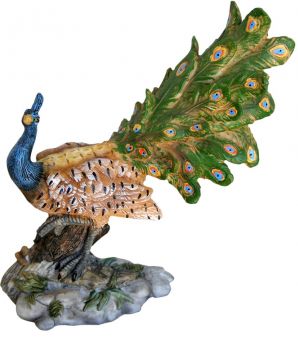
Once Radha came to a place on Barsana Hill not too far from her palace, up on a hillock just above Radha Kund. There were a few Gopis with Her and the weather was fair with just a few rain clouds shading the rays of the sun—just the kind of weather peacocks like. Soon a peacock came and, delighted to find Radha Rani there, he began to dance for Her. Slowly other peacocks came until there were thousands of peacocks dancing for Shree Radha among the flowering trees and creepers. After a short time, Krishn came and watched the enchanting beauty of the whole scene mesmerized by Radha’s beauty as She enjoyed the dance. Then He thought, “Why can’t I become a peacock and dance right in front of Radha Rani?” So He became a peacock. Of course He was the most charming and skilled of the peacocks and in His delightfully naughty way, He pushed Himself right to the front. Then He danced and danced for His Radha Rani, absorbed by Her love. The place of this leela is called Mor Kuti (left picture) which we also have here in Barsana Dham (right picture).

horizontal rule

Picture of small mandir dedicated to Lord Shiv at Prem Sarovar in Barsana, India (Varsana)
Picture of Gopeshwar Mahadev Mandir in Barsana Dham, Austin, Texas (a Hindu Temple and Ashram of bhakti yoga)

Gopeshwar Mahadev Shrine

Many temples and sarovars (holy ponds) in India have a Shiv mandir (left picture), however, the one established in Barsana Dham (right picture) is very unique and special. When Krishn played on His flute to indicate that He was going to do maharas, Shiv and Parvati rushed to Vrindaban. When Shiv (an almighty form of the supreme God) reached Vrindaban, He was told that without the permission of Radha Rani, the Goddess of maharas, no one could enter, and besides, only a Gopi can join maharas. Then ever-Gracious Radha Rani accepted His request and He was overjoyed. He immediately converted Himself into the form of a “Gopi” (a maiden of Braj) and entered Vrindaban. In this form His name is Gopeshwar. The Gopeshwar Mahadev Shrine in Barsana Dham represents Lord Shiv when He took the form of a Gopi so that He could enter maharas leela.

Please NOTE: This site requires the free Flash plug-in as well as java-script enabled in your web browser. Please ensure you have scripting turned on in your web browser and the most recent version of Flash installed so you can experience the graphics and multi-media presentations.